
In-mall advertising in the UAE works best when it follows the shopper’s walk. Nobody enters a mall to look at advertising; they arrive with a purpose, drift through a few spaces, stop to look at a few things and leave with a decision. Your brand should meet them at the moment that matters to your goal, not simply at the busiest spot.
Below we follow a typical visit from the car park to the checkout and show which placements suit each stage, then end with a comparison table and a short checklist for briefing a mall campaign.
Arrival: the car park and the entrances
The shopper’s first minutes are spent finding a space, parking and walking in, and that is a real opportunity for a simple message. Messages here should be brief, because people are carrying bags, watching for traffic or following a child.
Entrance zones suit announcements: a new store opening, an event, a season. Think of them as the headline of the visit, not the details. If a visitor learns only one thing about your brand on the way in, make it the thing you most want them to remember on the way out.
Entering: the atrium and the main concourse
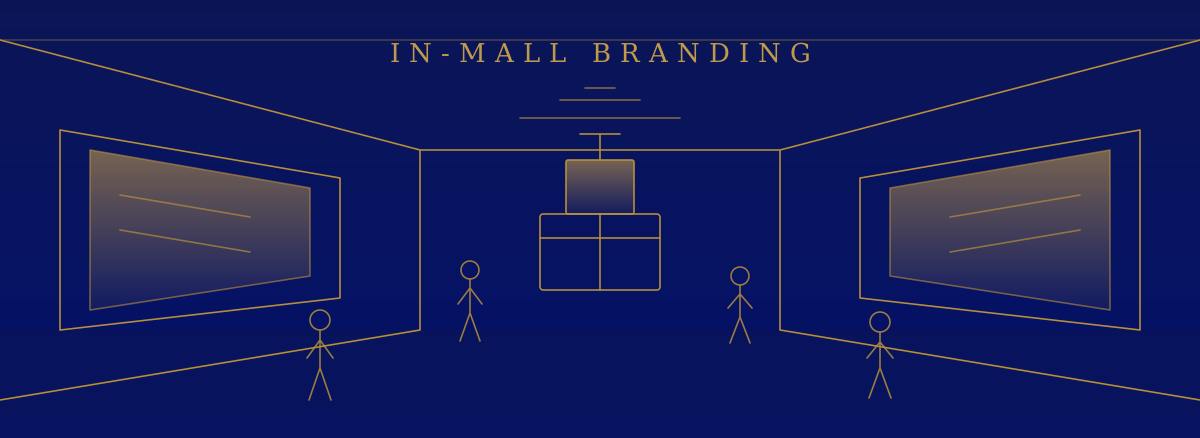
The central open spaces are where a mall shows itself off, and they are where large formats make sense. Hanging banners, large wraps on columns and glass, and big screens can all make a launch feel like an event. These spaces are also the most crowded with competing messages, so scale and simplicity matter.
A good rule is to ask what a person standing in the middle of the atrium could see if they turned slowly in a circle. If your message needs a second look to be understood, it has already lost to the neighbour next to it.
Browsing: corridors, escalators and lifts
While people walk and ride between floors, they are in a slower, more receptive mood. Escalator sides, lift interiors and corridor panels give a captive moment, and the message can be a little longer than at the entrance.
- Escalators. A rider faces the same view for several seconds, which suits a single clear image with a short line of text.
- Lifts. The audience is close and has little else to look at, so a simple, well-printed message can work well. Keep it tidy and uncluttered.
- Corridors. A run of panels lets you tell a message in sequence, one idea per panel, as shoppers walk past.
Digital screens in these spaces allow content to change through the day, which suits offers or time-limited events. Our LED screens page explains the options, and the in-mall branding page covers the full range of mall formats.
Deciding: close to the store or the shelf
The final stage is where intent turns into action. Placements near store fronts, food courts and queuing areas reach people who are already making a choice, so this is the place for specific offers, directions and calls to action that a shopper can act on immediately. Floor graphics, signs near entrances to a retailer and displays in rest areas fit here.
The most effective approach is usually to link the stages. The entrance or atrium creates awareness, the corridor repeats the idea, and the point-of-decision placement turns it into a reason to walk into a particular shop. For more on how stores use this logic, see our piece on how retail brands use billboards effectively, much of which applies indoors as well as outdoors.
Which placement for which goal
| Placement | Typical role | Message length | Good for |
|---|---|---|---|
| Car park and entrance | Announce | A few words | Openings, events, seasons |
| Atrium and concourse | Impress | One strong idea | Launches and brand moments |
| Escalators and lifts | Hold attention | Short line plus image | Awareness with a little more detail |
| Corridors | Tell in sequence | One idea per panel | Stories, product ranges |
| Near stores and food courts | Convert | Specific and actionable | Offers, directions, tastings |
Practical points when you plan a mall campaign
Malls are private venues with their own rules. Each management team sets its own requirements for content, sizes, finishes and installation, and many installations are planned around trading hours so that shoppers are not disturbed. That means the schedule depends on the mall as much as on the printer, and it is wise to confirm what a venue needs from you before the artwork is final.
Artwork also needs thought. Indoor lighting differs from daylight, and surfaces such as glass, columns and ceilings behave differently from a flat board. Ask for a proof and check it under the lighting that the finished piece will actually have. Because we print in-house and install with our own crews, we can look at both ends of that process together.
Timing matters, too. Shopping seasons and sales events draw crowds and competing advertisers at the same time, which affects availability. If your plan is built around those periods, our guide to White Friday and sales season outdoor planning shows how to think about timing.
Questions brands ask before booking a mall
Is mall advertising only for the shops inside the mall?
No. Shops inside use it to draw shoppers to their own doors, but brands that sell elsewhere use it too, because a mall gathers a varied, relaxed audience in one place. A bank, a telecom, a car brand or a property developer can all find the audience they want among shoppers. The retail industry page gives more detail on how we work with retail advertisers.
Should the creative match our roadside campaign?
The idea should match; the execution should not. A roadside board is read in a glance, while a lift panel or a corridor display can carry a little more. Keep the same look, the same tone and the same core line, then rebuild the layout for each surface so it feels designed for the place.
Can mall advertising work on its own?
It can, especially for local or event-driven goals. For awareness across a wider area, it usually works better as the closing stage of a plan that begins on the road and ends in the mall, where interest meets the chance to act.
A short checklist for your brief
- What is the one thing a shopper should do or remember?
- Which stage of the visit are you talking to: arrival, browsing or decision?
- Which malls fit your customers, and what are their requirements?
- How will the artwork be adapted to each surface and viewing distance?
- Who maintains the installation, and how will it be checked during the campaign?
- How will you tell whether it worked, for example footfall to a store or use of an offer?
If you are planning a mall campaign, talk to Al Masa about in-mall advertising and bring your objective, your target shoppers and the malls you have in mind. We will help you match each stage of the visit to a placement.