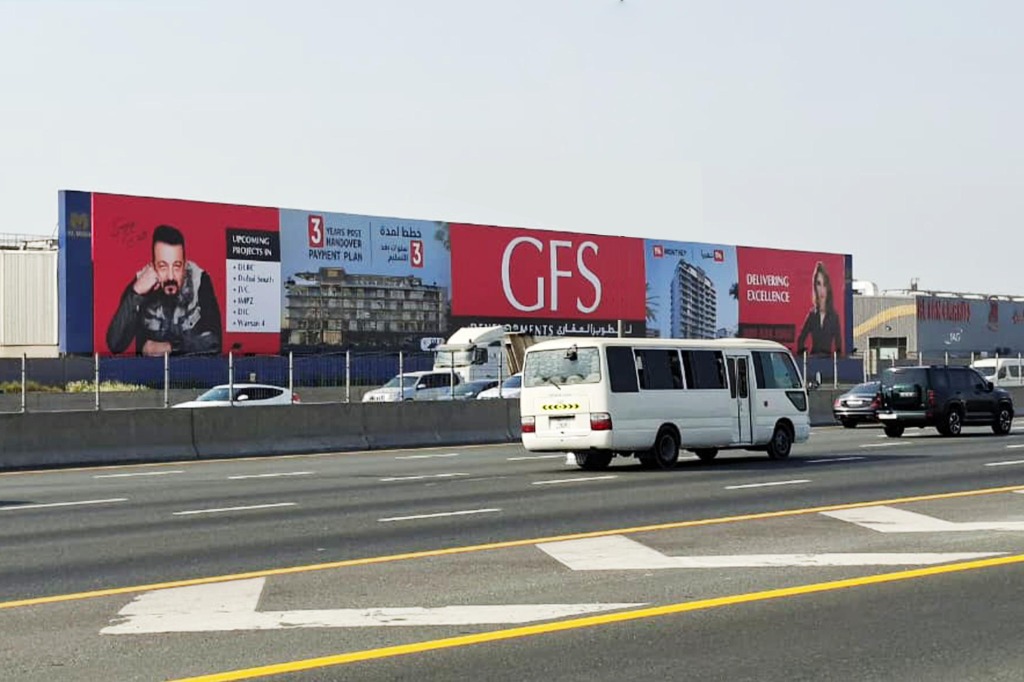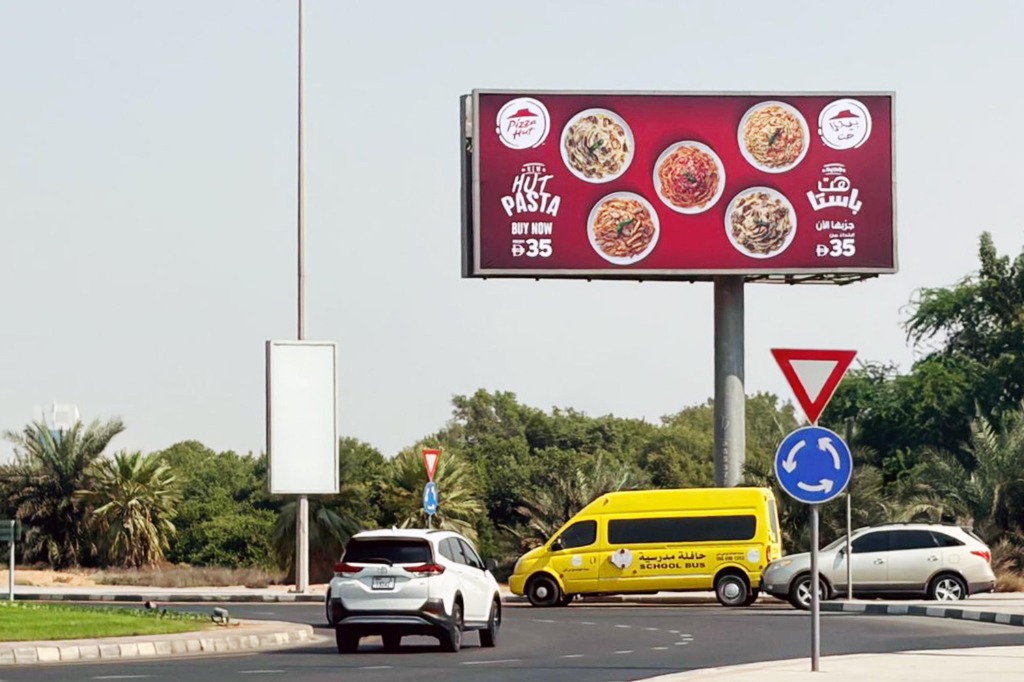

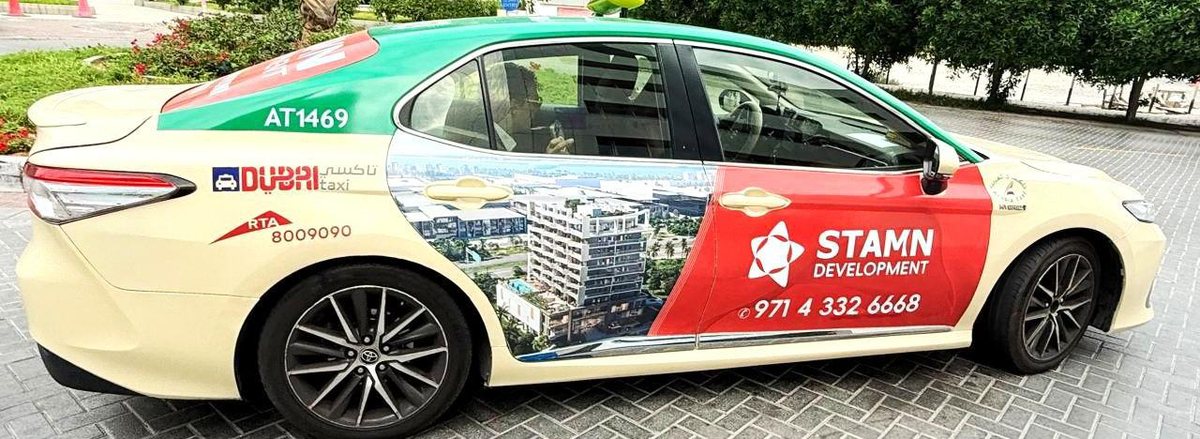
Taxi branding in the UAE is a moving form of outdoor advertising: your design is printed on vinyl, fitted to a vehicle and carried through the streets where the vehicle works. Unlike a billboard, it does not wait for the audience; it travels through business districts, residential streets, airports and shopping areas in the course of an ordinary day.
That freedom is the appeal, and it is also why the process needs care. A vehicle is a curved, textured, hard-working surface, and a design that looks perfect on screen can fail on a door handle or a wheel arch. Below is the process in the order it happens, with the decisions that matter at each stage.
Step 1: Decide what the vehicles are for
The first question is not about design but about the job. A wrap on a taxi that moves across the whole city suits a brand that wants broad, repeated visibility. A wrap on your own delivery vans or sales fleet suits a brand that wants to be recognised wherever its people work.
These are different projects. With taxis you are borrowing a surface and a route that you do not fully control, so the message must work anywhere. With your own fleet you control the vehicle and the route, so the design can carry detail, contact information and a consistent look across every vehicle. If you are still weighing this against other formats, our overview of the types of outdoor advertising in the UAE puts vehicle branding in context.
Step 2: Design for a moving, curved surface
A vehicle is seen from the side, the rear and the front, often at an angle, and usually in motion. Design for that reality. The idea should survive being cut by door seams, window frames and body lines, and the key words should sit on the flattest areas rather than across a deep curve.
- Keep the main message large and short so it can be read from the next lane.
- Put the brand name where the vehicle is most often seen from the side, not on a recess or a curve.
- Use strong contrast between text and background; colour behaves differently in sunlight and under street lighting.
- Keep important text clear of door handles, fuel caps, lights and sensors.
- Plan Arabic and English together so neither is squeezed.
Design for the specific vehicle model, not a generic outline. The template for one model rarely fits another exactly, and a correct template is what stops a logo being cut in half by a panel gap. Our graphic design team builds artwork on the vehicle template from the start.
Step 3: Agree who can approve what
Before artwork is finalised, find out who has the right to approve advertising on the vehicles. For taxis this is generally a combination of the vehicle operator and the relevant authority; for your own fleet it is your own management plus whatever the authority requires. Rules and approval processes differ by emirate and by authority, so check with the relevant authority and do not assume a design cleared in one place is cleared everywhere.
Al Masa handles approvals for its own advertising inventory, and for vehicle projects we coordinate the required sign-offs with the vehicle owner so that nothing is printed before it has been cleared. It is cheaper to catch a problem at this stage than after the vinyl has been produced.
Step 4: Print on the right material
Vehicle graphics use large-format printing on vinyl made for vehicle surfaces. The material, the finish and the protective layer all affect how the wrap looks and how long it lasts under sun, washing and constant movement. We print in-house, which keeps colour checks and corrections under our own control. Ask to see a colour proof before the full run is produced.
Ask what finish will be used. A gloss finish can reflect sunlight strongly, while a matt finish is softer to the eye but may mark differently. Both can work, and the right choice depends on the design and where the vehicle operates. You can see the printing side of the work on our large-format print page.
Step 5: Installation, surface by surface
Installation is a skilled job, not a sticker job. The vehicle must be clean and free of grease, the surface checked for damage, and each panel fitted in a clear order so that seams and edges land where the design intended. Handles, lights and trims are treated with care, and the finished vehicle is inspected before it returns to work.
We install with our own crews. For a fleet, a sensible approach is to treat the first vehicle as a pilot, approve how it looks and sits, then repeat the same method across the rest so that every vehicle matches. Details such as where one panel ends and the next begins are worth agreeing on the pilot, not discovering on the tenth vehicle.
Step 6: Keep it clean, check it and plan the end
A wrap is on public display for the whole booking, so condition matters as much as the first impression. Damaged, peeling or dirty graphics send the wrong signal, and a vehicle that looks neglected reflects on the brand it carries.
- Inspect a sample of vehicles on a regular schedule.
- Repair or replace panels that are scratched, torn or lifting.
- Wash according to the installer’s guidance, avoiding harsh cleaning on the printed surface.
- At the end of the campaign, have the graphics removed by trained crews so the paint underneath is not harmed.
A short checklist before you sign off
Before the vinyl is printed, run through a few questions with whoever owns the vehicles. A quick review here saves rework later.
- Has the design been built on the correct template for each vehicle model?
- Can the main message be read from a distance, on all visible sides?
- Are logos, phone numbers and web addresses clear of handles, lights and gaps between panels?
- Has the vehicle owner, and where needed the relevant authority, approved the artwork?
- Who will inspect the vehicles during the campaign, and how often?
- What happens to the graphics at the end: removal, replacement or renewal?
If any answer is “we will decide later”, that is usually where the problems start.
Taxi branding or fleet wrap: which fits?
| Question | Taxi branding | Your own fleet wrap |
|---|---|---|
| Who controls the route? | Not you; it covers wherever the taxi works | You, through your own operations |
| Best for | City-wide visibility and repeated sightings | Brand consistency and being recognised on the job |
| Design depth | Short and bold | Can carry more information |
| Main risk | Message that does not travel well | Inconsistent look across vehicles |
For company vehicles, see the vehicle and fleet wraps page, and for taxis the taxi branding page. If you are ready to scope a project, talk to Al Masa about vehicle branding and tell us how many vehicles, which models and what the campaign has to do.