
Outdoor advertising in Sharjah, Ajman and the rest of the northern emirates works best when you plan each emirate by the way its people actually move. The northern emirates are connected by busy roads and shared daily journeys, yet each has its own character, its own authority and its own pattern of weekday and weekend traffic. Treating them as one block is the quickest way to spend well and reach poorly.
This is a tour rather than a rulebook. We take the emirates one by one, then look at how to join them into a single campaign and which format suits which kind of goal.
Why the northern emirates deserve their own plan
Many media plans in the UAE are drawn around Dubai and Abu Dhabi, with the north added as an afterthought. That leaves out a large number of people who live, shop and drive in these emirates every day, and it ignores something an outdoor planner values: shorter, more predictable routes where a handful of sites can be seen repeatedly by the same people.
It also matters that people cross emirate lines constantly. A resident of one emirate may work in another and shop in a third, so a campaign that appears at each end of a commute is seen twice a day, even though the two ends belong to different authorities and different sets of rules. Al Masa owns and operates its network in all seven emirates, which makes it possible to plan those journeys end to end.
Sharjah: busy corridors and a strong local identity
Sharjah sits next to Dubai and shares a heavy flow of daily traffic with it, so the roads that link the two emirates carry a very mixed audience. Boards on those corridors reach commuters from both sides, while sites deeper inside the emirate reach residents who are less exposed to Dubai media.
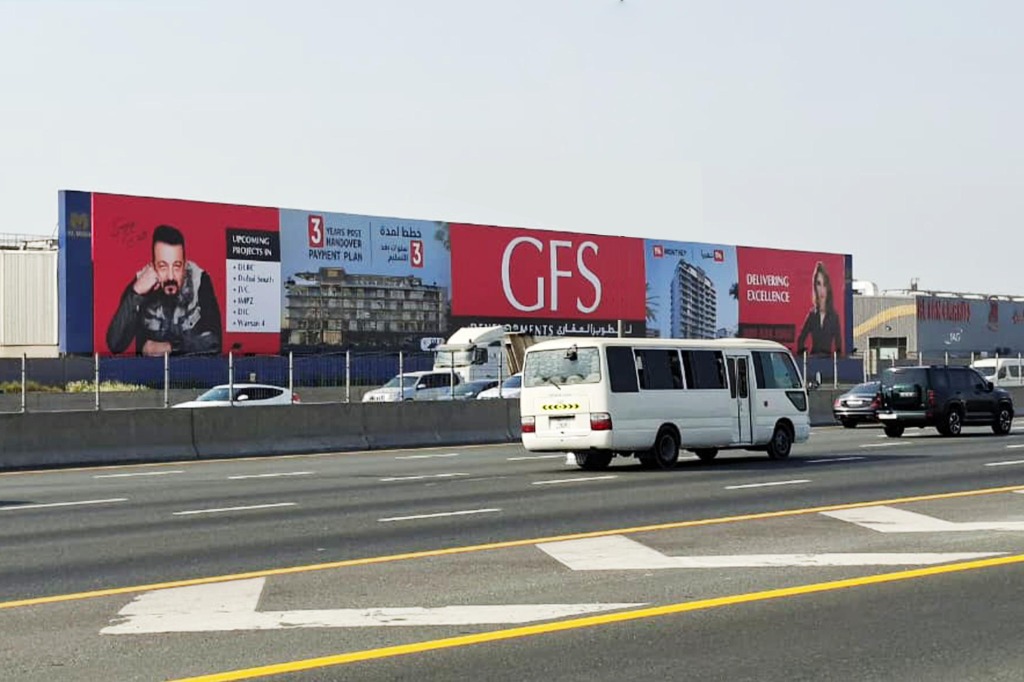
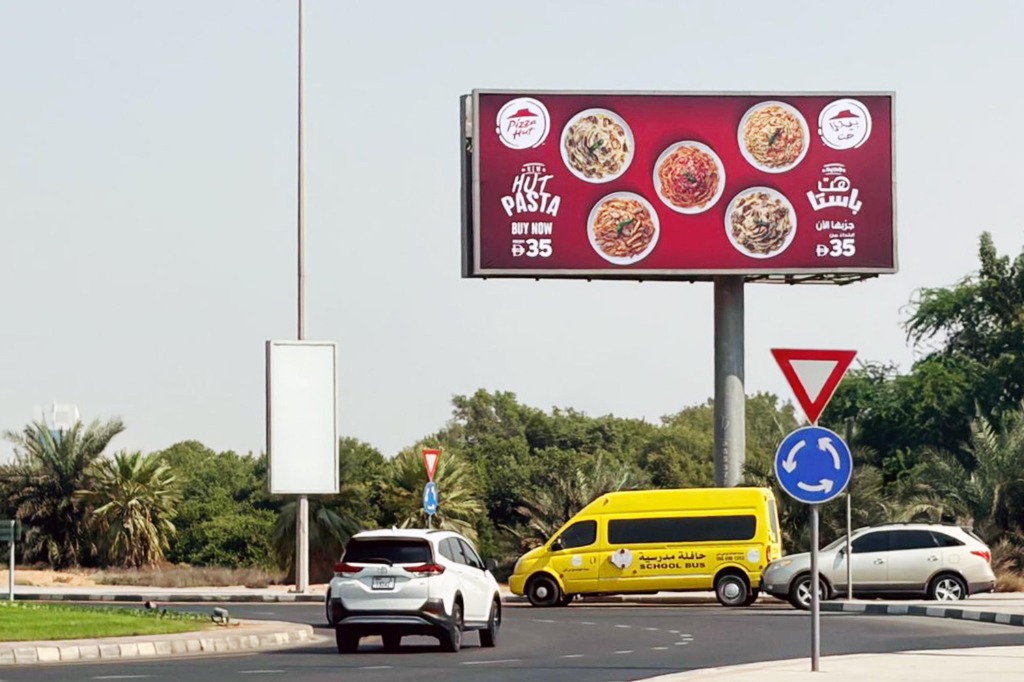
Sharjah also has a distinct cultural tone, and creative should respect it. Keep imagery and wording considered, give Arabic proper weight and check your design against the local setting rather than assuming a Dubai campaign can be dropped in unchanged. Large faces such as unipoles and hoardings suit the main approach roads, while lamppost advertising works for repeating a message along a retail or residential street. Our Sharjah location page shows how we cover the emirate.
Ajman: compact, dense and closely tied to its neighbours
Ajman is smaller in area, which is an advantage for planning. Journeys inside the emirate are short and the main roads are few, so a well-chosen site tends to be seen again and again by the same drivers. That repetition is exactly what builds recall.
Ajman is also closely tied to Sharjah and Dubai through daily movement, so it works well as part of a wider commuter-belt campaign rather than as an isolated market. Consider it when your customers are residents and workers in the northern corridor, and look at the Ajman page when you start choosing sites.
Ras Al Khaimah and Umm Al Quwain: two different kinds of reach
These two emirates are often grouped together on a map, but they behave differently for advertisers.
- Ras Al Khaimah combines residential areas, working districts and leisure destinations, so it suits campaigns with several audiences: residents, day visitors and weekend travellers. Plan by journey type, because the main road on a Friday afternoon serves a different crowd from the same road on a Monday morning. See the Ras Al Khaimah page for coverage.
- Umm Al Quwain is quieter and more local. Fewer routes means each site has to be chosen with care, but a well-placed face can dominate a small number of busy roads that most residents use. The Umm Al Quwain page explains how we cover it.
Neither is a place to copy a Dubai plan. The scale of the audience is different, so the number and size of structures should be too.
Fujairah and the east coast: a different side of the country
Fujairah and the east coast face the Gulf of Oman rather than the Arabian Gulf, and the traffic pattern reflects that. Roads there link towns that are further apart, and people travel in from the west for work, leisure and logistics. For brands that want to reach the east coast, large-format sites on the main approach roads are usually the starting point.
Al Masa has an office in Fujairah and a branch in Khorfakkan, which means installations and maintenance on this side of the country are handled by people who are already nearby, not driven across from elsewhere. If your plan includes the east coast, read the Fujairah page and tell us which towns matter most to you.
Choosing formats: a short decision guide
Use your goal to narrow the format, then your route to place it.
- You want broad awareness fast. Large faces on the main inter-emirate roads, such as unipoles and hoardings, give the most visibility for a single message.
- You want a message repeated in a neighbourhood. Lampposts and smaller roadside faces build familiarity along streets that residents use daily.
- You want to point people to a place. Place boards on approach roads, a short distance before the turn, with a clear name and direction.
- You want one visible landmark. A single high-impact structure or a building wrap can make a launch memorable in a smaller market.
Mistakes brands make when they treat the north as one market
- Scaling a Dubai plan down. Fewer sites on shorter routes need sharper placement, not a smaller copy of a larger plan.
- Ignoring the evening and weekend routes. Residents leave the house for different reasons at different hours, and the roads they use change with them.
- Using one set of artwork sizes everywhere. Each structure has its own proportions, so the master design needs a version for every face.
- Forgetting maintenance on distant sites. A faded or torn face does more harm than no face, so ask who looks after each site through the booking.
Most of these come down to the same thing: decide who you want to reach, trace where they travel, and let the sites follow the routes rather than the other way round.
Planning across several emirates at once
A multi-emirate campaign is easier to manage when you keep the creative constant and make the plan flexible. Use one idea and one set of master artwork, then adapt sizes for each structure. Let the site list vary by emirate, because routes, structures and approvals vary.
On approvals, rules and processes differ by emirate and by authority, so check with the relevant authority wherever you plan to advertise. For our own sites, Al Masa handles the approvals, which keeps one team responsible for the whole schedule. A sensible order is to agree the objective, shortlist the corridors, confirm availability, start approvals, finalise artwork, print in-house and install with our own crews.
If you are working out where to begin, talk to Al Masa about a northern emirates campaign and tell us which emirates your customers travel between. We will suggest a short list of corridors and formats to start from.