
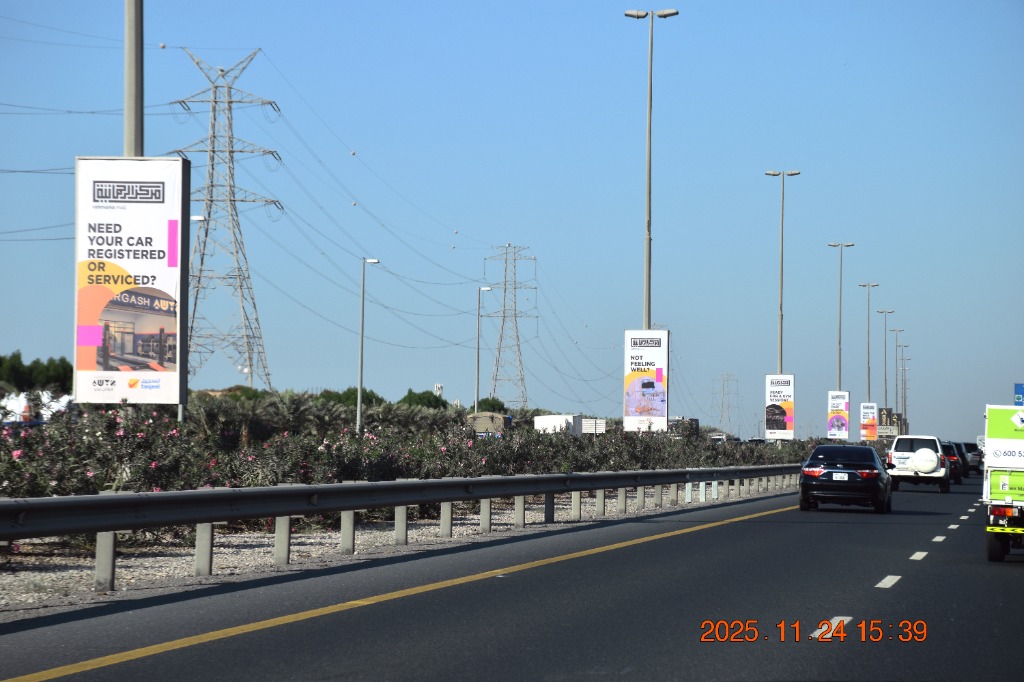
Lamppost advertising in Dubai works best as a sequence rather than a single hit. A lamppost panel is small, and one panel on its own can be missed. But lampposts come in lines along streets and boulevards, so the same message repeats as people drive or walk past, and familiarity builds through repetition. If you plan the sequence well, a modest panel can make a brand feel present along an entire route.
This guide treats lampposts the way we plan them: as a route to design, not a site to buy. It covers what a panel can carry, three patterns for planning a route, how to sequence a message, and the questions to settle before booking.
Why a lamppost campaign is a route, not a site
With a unipole or a hoarding, the question is where to stand. With lampposts, the question is where to run. A line of panels along a boulevard gives the audience repeated, short exposures, each reinforcing the last. The value is in the accumulation, not in any one panel.
That changes how you evaluate a proposal. Do not ask how good a single lamppost is. Ask how the full run of panels reads as someone travels through it: where it starts, where it ends, which direction people usually move, and what sits at either end.
What a lamppost panel can and cannot carry
A lamppost panel suits a short, clear line and a recognisable brand mark. It is a poor home for a paragraph, a product comparison or a phone number that someone has to remember. The panel is seen by passers-by briefly, usually from an angle, and often at the edge of their attention.
What works
- A single bold word or short phrase, set large.
- A recognisable logo or visual device repeated consistently.
- A simple direction, such as a venue name and an arrow, when the panel is close to the destination.
- Strong colour that separates the panel from its background, whether sky, trees or buildings.
What does not
- Small print, terms or lists of features.
- Detailed photographs that depend on fine texture.
- Different messages on neighbouring panels with no visible link between them.
Three patterns for planning a route
The corridor pattern
Use a main road as the spine and run panels along a long stretch of it. This suits brand awareness and fits well with a larger roadside presence at the key points. Pair it with a structure like a bridge banner if you want one strong head-on moment among the repetition.
The district pattern
Concentrate panels inside a single neighbourhood or commercial area, so that residents and visitors meet the message on most of their local journeys. This suits a venue, a community launch or a retailer whose customers live or work nearby.
The approach pattern
Place panels on the roads leading to a single destination, so that the last stretch of the journey is lined with the message. This suits events and openings, where the aim is to pull people towards a specific place at a specific time. Our guide to outdoor advertising for event promotion shows how this fits into a wider plan.
Sequencing a message along the route
Because people meet the panels in order, you can use the order. A well-designed sequence turns a line of lampposts into a short story told at street pace. Here is a simple three-part structure.
- Tease: the first panels carry the brand mark and a curiosity-raising line.
- Reveal: the middle panels state what is happening, whether a launch, an event or an offer.
- Direct: the final panels tell people where to go, using the venue name and a clear direction.
Keep a shared visual system across all three: the same typeface, colour and logo position. If the panels look like different campaigns, the accumulation is lost. A sequence also has to work for people who see only one panel, so each one should make sense alone even while contributing to the whole.
Street furniture beyond the lamppost
Street furniture is the family of urban fittings that people use or pass every day, and lampposts are one of its most visible members. Other fittings can carry advertising as well, but they are different formats, with their own audiences, specifications and operators. Where your plan includes more than lampposts, treat each as a separate booking and confirm who operates it and which authority’s rules apply.
Al Masa focuses on the lamppost format within this family, together with the wider set of roadside, building and in-mall formats on its network. If you are comparing lampposts with other formats, our overview of the types of outdoor advertising in the UAE is a good starting point.
Timing lamppost campaigns in Dubai
Lampposts suit campaigns that are tied to a moment: a festival, a seasonal sale, a venue opening. During busy retail periods, the neighbourhoods around shopping destinations see a lot of local movement, which is where repetition pays off. For planning around the biggest shopping events, see our notes on Dubai Shopping Festival outdoor planning. As ever, check dates and approvals early, since street-level locations are shared with many other uses.
Mistakes that weaken a lamppost campaign
- Treating each panel as a mini billboard. The panel is small and the exposure is short. Cramming a billboard’s worth of content into it makes it unreadable.
- Buying scattered panels. A few lampposts spread across unrelated streets cannot build repetition. If the budget is limited, shorten the route rather than thinning it out.
- Ignoring the end of the route. A sequence that fades out leaves people wondering. Finish at a destination, a venue or a clear next step.
- Forgetting the evening. Street lighting and colour choices decide whether a panel still reads after dark, so look at the route at night before approving it.
If your streets fall within Dubai, we can discuss which routes suit your audience and which panels are available. Elsewhere in the UAE, the same planning logic applies, adjusted for local roads and authorities.
A checklist before you book
- Is the message short enough to read in a glance?
- Does the route match where your audience actually travels?
- Do the panels face the direction of movement, so people see them approaching?
- Will construction, trees or signage block the panels during the booking?
- Who approves, installs and maintains the panels, and who replaces any that are damaged?
- Is there a clear end point, such as a venue or a web address, that rewards the final panel?
Rules and approval processes differ by emirate and by authority, so check with the relevant authority for any specific street. For its own network, Al Masa handles approvals, printing, installation and maintenance during the campaign. To plan a route with our team, see our lamppost advertising page or talk to Al Masa through our contact page and tell us which streets and dates you have in mind.