
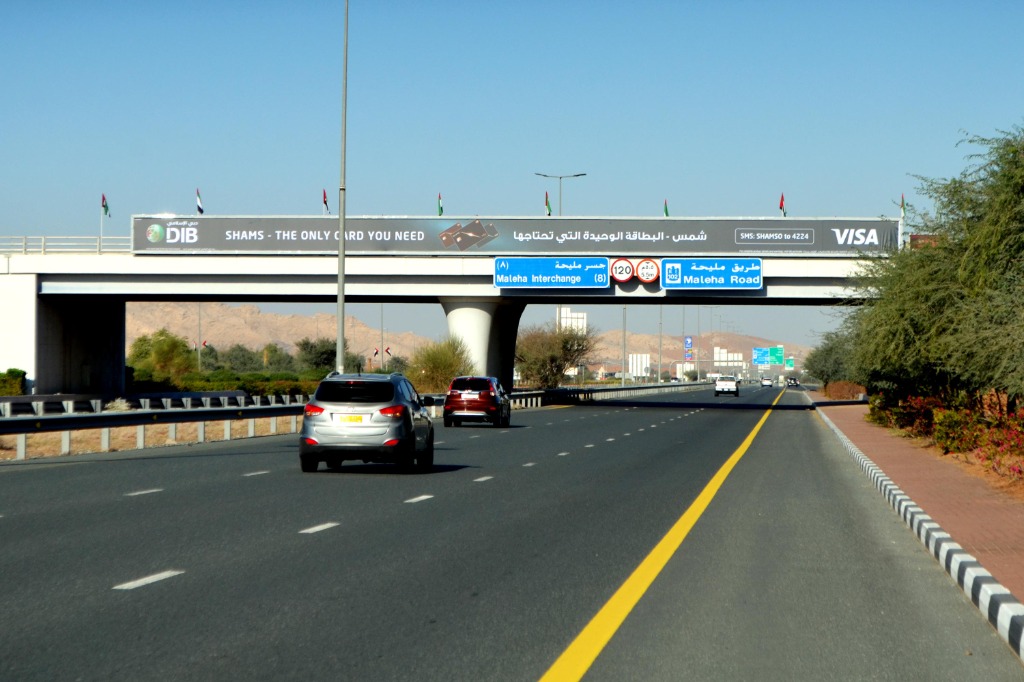
Bridge banner advertising in the UAE places a large printed banner on a road or pedestrian bridge so that it faces approaching drivers head-on. Because the banner hangs over the route itself, there is no angle to compensate for and no distance to guess: the driver sees it as part of the road. It works best for a short, bold message on a corridor where you want to be present every day.
What makes bridge banners different from other formats is how much happens before the first driver sees one. The bridge has to be chosen carefully, the design has to survive wind, and the installation has to be done by people trained to work at height. This guide follows the full life of a banner, step by step.
Why bridge banner advertising works on busy routes
A bridge banner has three natural advantages. First, it faces the traffic directly, so the message is read square-on instead of from the side. Second, it sits across the driver’s line of travel, where attention is already directed. Third, it is part of the infrastructure, which makes it feel like a fixture of the route rather than an intrusion.
The trade-off is that you are working with the bridge as it exists. You cannot move it, raise it or widen it, so the selection of the bridge matters more than almost any other decision in the campaign.
The bridge banner process, step by step
Step one: choose the bridge and the direction
Start with the route your audience actually drives. A bridge may serve traffic in both directions, but only one direction will carry the people you are trying to reach, so decide which face the banner should show. Think about speed, too: the faster the approach, the shorter the message must be. Our guide to advertising on Sheikh Zayed Road shows how a single corridor can contain very different audiences.
Step two: confirm approvals
Bridges belong to the road authority, not to the advertiser, so approvals work differently from a private plot. Rules and approval processes differ by emirate and by authority, and you should check with the relevant authority for any bridge you are considering. For bridges in its own network, Al Masa handles approvals as part of the service.
Step three: design for distance and wind
A banner is a large, flexible surface exposed to moving air. The material, the way it is finished and the way it is attached all affect how it behaves in wind, and the design should avoid fine detail that depends on a perfectly flat surface. We return to design rules in the next section.
Step four: print and prepare
Banners are printed in large format and prepared with reinforced edges and fixings suited to the bridge. Because Al Masa prints in-house, the same team that checks the colours also prepares the finishing, which reduces the chance of a mismatch between what the designer approved and what arrives on site.
Step five: install with trained crews
Installation on a bridge is specialist work. It involves rope-access and high-reach techniques, safe working practices around live traffic, and careful coordination of timing. This is not a task for a general contractor with a ladder, and the quality of the fixing determines how the banner looks and how long it lasts.
Step six: inspect during the campaign
A banner exposed to sun, dust and wind needs to be checked. Look for loosened fixings, edge wear and fading, and agree in advance who inspects and how quickly a problem is fixed. Maintenance during the campaign should be part of the arrangement, not an extra negotiation.
Step seven: remove cleanly
At the end of the booking, the banner has to come down safely and the bridge has to be left as it was found. Agree this in writing at the start so that removal is not forgotten once the creative team has moved on.
Designing a banner that reads from a moving car
The driver has only a few seconds, and a bridge banner is read from below and ahead, so the design must be forgiving. Use this checklist before approving artwork.
- One message only. If you cannot say it in a handful of words, it does not belong here.
- Large, simple type with strong contrast against the background.
- The logo in a clear area, not squeezed into a corner.
- No fine lines or small print that disappear at distance or ripple with the surface.
- Colours that stay distinct under strong sun and in the evening.
Our artwork and file checklist covers the technical file requirements that apply to large-format print.
How bridge banners compare with other roadside formats
Bridge banners and unipoles often appear on the same shortlist, and they serve different roles. A unipole lifts a board above the road beside the carriageway. A bridge banner crosses the carriageway. Used together on one route, they give a campaign both a head-on moment and a roadside presence. For the wider picture, see our overview of the types of outdoor advertising in the UAE.
What can go wrong, and how to avoid it
- Too much copy. A banner crowded with offers becomes a pattern of grey shapes. Cut until only one idea remains.
- Wrong direction. A well-designed banner facing the wrong traffic wastes the booking, so confirm which way the face points.
- Underestimating wind. A banner that flaps or tears is worse than none. Insist on a construction suited to the bridge.
- Last-minute artwork. Late files compress printing and installation, and installation on a bridge is the last place to rush.
- No maintenance plan. If nobody is responsible for inspection, a small problem can turn into a visible one.
Questions brands ask before booking a bridge
Will it be visible after dark?
That depends on the bridge and its surroundings. Some bridges have street lighting nearby, others do not, and a banner is not lit like a board on a structure. Ask what lighting exists at the bridge and choose colours with strong contrast so that the message still reads in low light.
Can the message change during the booking?
A banner is printed and fixed, so changing it means taking it down and installing a new one. If your message is likely to change, a screen or a replaceable board may serve you better. If it is stable, a banner suits you well, and our comparison of static billboards and digital screens explains the difference.
How long should a banner stay up?
Long enough for the route’s regular drivers to see it repeatedly, and short enough that the message is still relevant and the banner still looks fresh. Weather and sun exposure shape the answer, so ask your supplier how the banner should be expected to age in your chosen location.
Who bridge banners suit best
Bridge banners tend to suit messages that benefit from daily repetition on a defined route: a retailer announcing a seasonal event, a developer building awareness for a project, or a public-sector body communicating a campaign to commuters. Our pages for government communications and real estate show how those sectors approach outdoor media.
If a particular bridge is on your mind, send us the route, the audience and your dates. Talk to Al Masa about bridge banner advertising through our contact page, and we will tell you plainly whether the bridge fits your message.